Part ofBefore They Were Famous
Six Women Programmed the First Electronic Computer. The Captions Left Them Out.
The machine got a press launch in 1946. The people who worked out how to make it compute were not invited to the dinner.
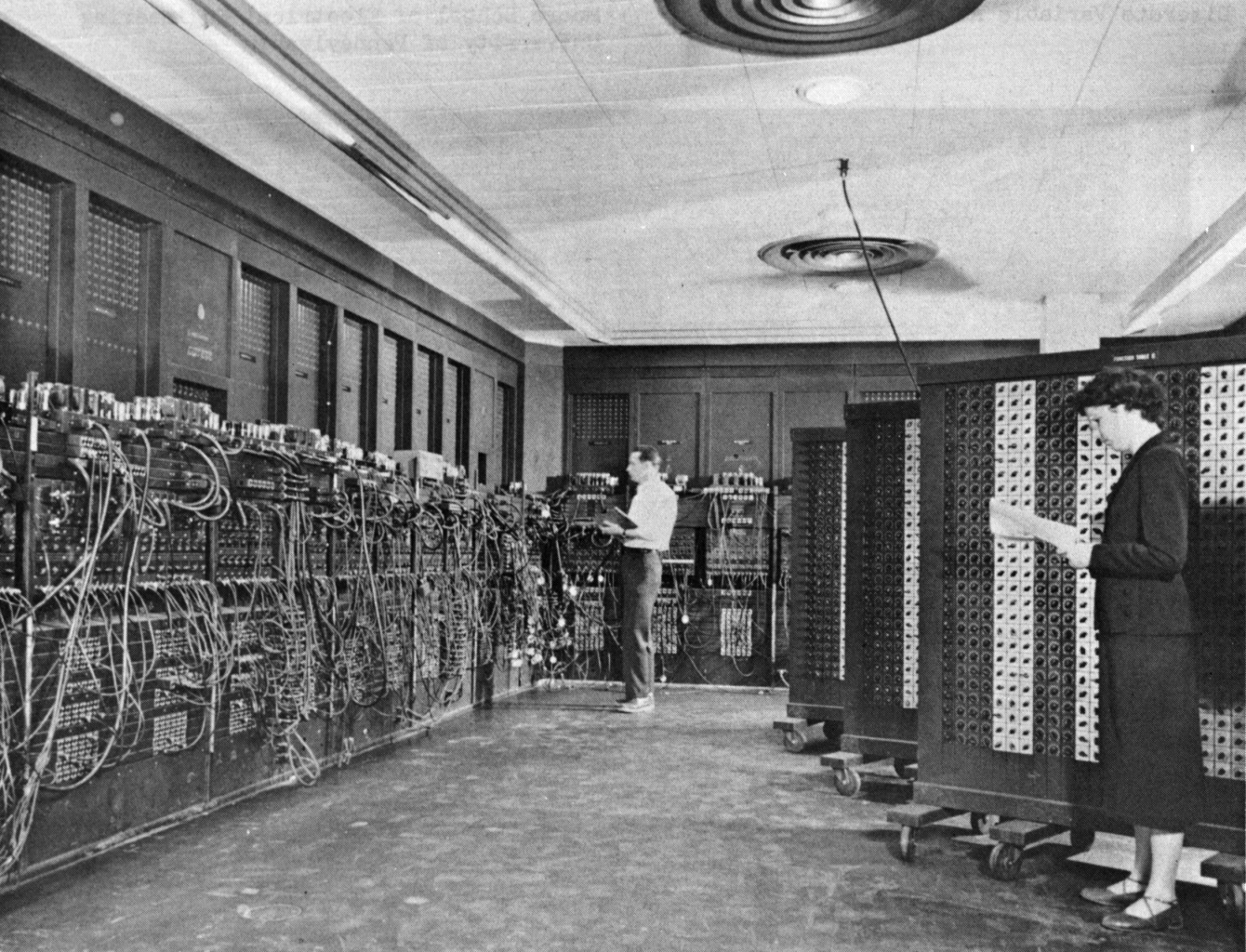 Unknown (US Army photograph) / Public domain
ENIAC was built at the University of Pennsylvania during the Second World War to compute artillery firing tables. It had no stored program. To make it solve a new problem you rewired it: setting switches, moving cables, physically reconfiguring the machine.
That work fell to a team of six women recruited from the ranks of human “computers” — Kathleen McNulty, Betty Jennings, Betty Snyder, Marlyn Wescoff, Frances Bilas and Ruth Lichterman.
What 'computer' meant before it meant a machine
The word described a job, not a device. Ballistics work required enormous quantities of arithmetic, and universities and army laboratories employed rooms of people — overwhelmingly women, many with mathematics degrees — to grind through trajectory calculations by hand and on desk calculators. A single firing table could take weeks of human effort.
The six women assigned to ENIAC came from that pool. They were hired because they already understood the mathematics the machine was being built to accelerate, which is precisely why they were the people capable of working out how to instruct it.
Learning a machine they were not allowed to see
They began by studying the wiring diagrams, because the machine sat in a restricted area. When they finally got access, they debugged it by tracing individual vacuum tubes among the roughly 18,000 the machine contained.
There was no programming language, no manual and no prior art. Setting up a problem meant decomposing it mathematically, then expressing that decomposition as a physical configuration of switches and patch cables, then finding out by hand where the machine's arithmetic was going wrong. The techniques they developed for isolating faults — working backwards from a wrong answer to the specific unit producing it — are recognisable as debugging in the modern sense, invented because the job required it.
For ENIAC's public unveiling in February 1946 they programmed a ballistic trajectory demonstration. The press covered the machine. The programmers were not named in most of the coverage, and were not included in the celebratory dinner that followed.
- ENIAC weighed about 30 tons and occupied a room roughly 30 by 50 feet.
- Reprogramming it could take days of physical rewiring.
- Betty Snyder (later Holberton) went on to work on UNIVAC and the standardisation of COBOL and FORTRAN.
- Jean Bartik (Betty Jennings) led work on converting ENIAC to stored-program operation after the war.
- Several of the women in ENIAC publicity photographs went unidentified in archives for decades before researchers named them in the 1980s and 1990s.
 Continue reading · What happened next?The Most Reproduced Photograph in History Was Taken Through a Spacecraft WindowApollo 17's crew had the Sun behind them and a hand-held Hasselblad. The result went round the world before the astronauts did — and it is free for anyone to use.
How the captions got fixed
For years the standard assumption about army publicity photographs of ENIAC was that the women standing at the machine were models posed for the shot — “refrigerator ladies,” in the phrase used to describe the way appliances were advertised at the time. Archives recorded the men by name and left the women unidentified.
That was corrected by research rather than by the institutions themselves. From the mid-1980s onwards, historians and researchers tracked down surviving members of the team, recorded oral histories and matched faces in the photographs to names. The women were publicly honoured decades after the fact, several of them late in life, and the archival records were amended.
It is a specific and repeatable lesson about photographic archives: an uncaptioned person is not an anonymous person. They are a person nobody wrote down.
What the picture shows
This US Army photograph is catalogued with two names — Glen Beck and Betty Snyder — which already makes it better documented than most images from the programme. It is a public-domain government photograph, and it is the kind of frame that quietly corrects a story most people learned wrong.
Image record & sources
- Photographer
- Unknown (US Army photograph)
- Date made
- c. 1947–1955
- Collection
- US Army / Wikimedia Commons
- Licence
- Public domain
- Attribution
- US Army photograph. Public domain.
- File checked
- Licence page for this exact file — verified 29 August 2026
References
Tags
About the author
Forgotten Frame Editorial Desk
Editorial team
The Forgotten Frame editorial desk researches photographic archives, checks the licence of every individual file we publish, and writes the verified context around each picture.