Part ofThe Photo That Changed Everything
The Most Reproduced Photograph in History Was Taken Through a Spacecraft Window
Fully lit, dead centre, no crescent shadow: a photograph that could only be made on one specific trajectory, on one specific day.
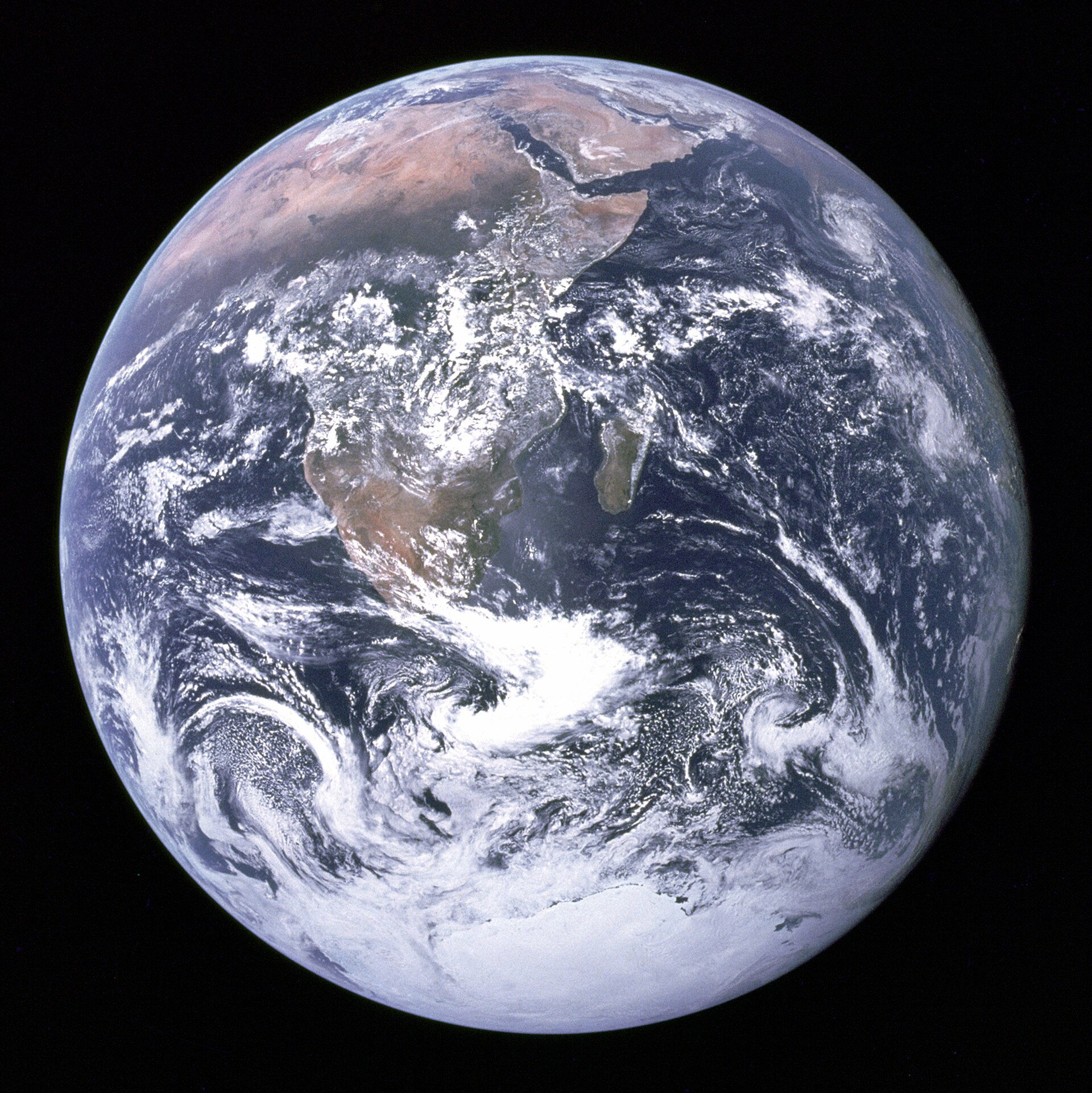 Apollo 17 crew (NASA) / Public domain
On 7 December 1972, about five hours after launch and roughly 45,000 kilometres out, the Apollo 17 crew photographed the Earth with a hand-held 70 mm Hasselblad. The Sun was almost directly behind the spacecraft, so the planet appears fully illuminated rather than as the usual crescent.
The southern hemisphere is turned towards the camera: Africa, the Arabian peninsula, a heavy cyclone system in the Indian Ocean, and the Antarctic ice cap, which was unusually well lit because of the December solstice.
The alignment that made it possible
A fully lit Earth is not something you can decide to photograph. It requires the spacecraft to be almost exactly between the Sun and the planet, far enough out for the whole disc to fit the frame, with a clear window and a camera in someone's hands at that moment. Apollo 17's trajectory and launch time — it lifted off at night, on the last crewed flight to the Moon — put the crew in that position for a short window early in the outbound coast.
The Antarctic ice being visible at all is a separate accident of timing. In December the southern polar region is in continuous daylight, so the bottom of the disc is bright instead of black. Fly the same mission in June and the photograph does not exist in this form.
Which astronaut pressed the shutter?
NASA credits the crew rather than an individual. All three men — Eugene Cernan, Ron Evans and Harrison Schmitt — were trained on the cameras, and the flight logs do not settle it. Schmitt has said he believes the frame was his. NASA's own caption remains cautious, and so do we.
The image was also published upside down relative to the original frame. The raw photograph has Antarctica at the top; the version the world knows was rotated to match the convention that north is up.
It landed on ground that had been prepared
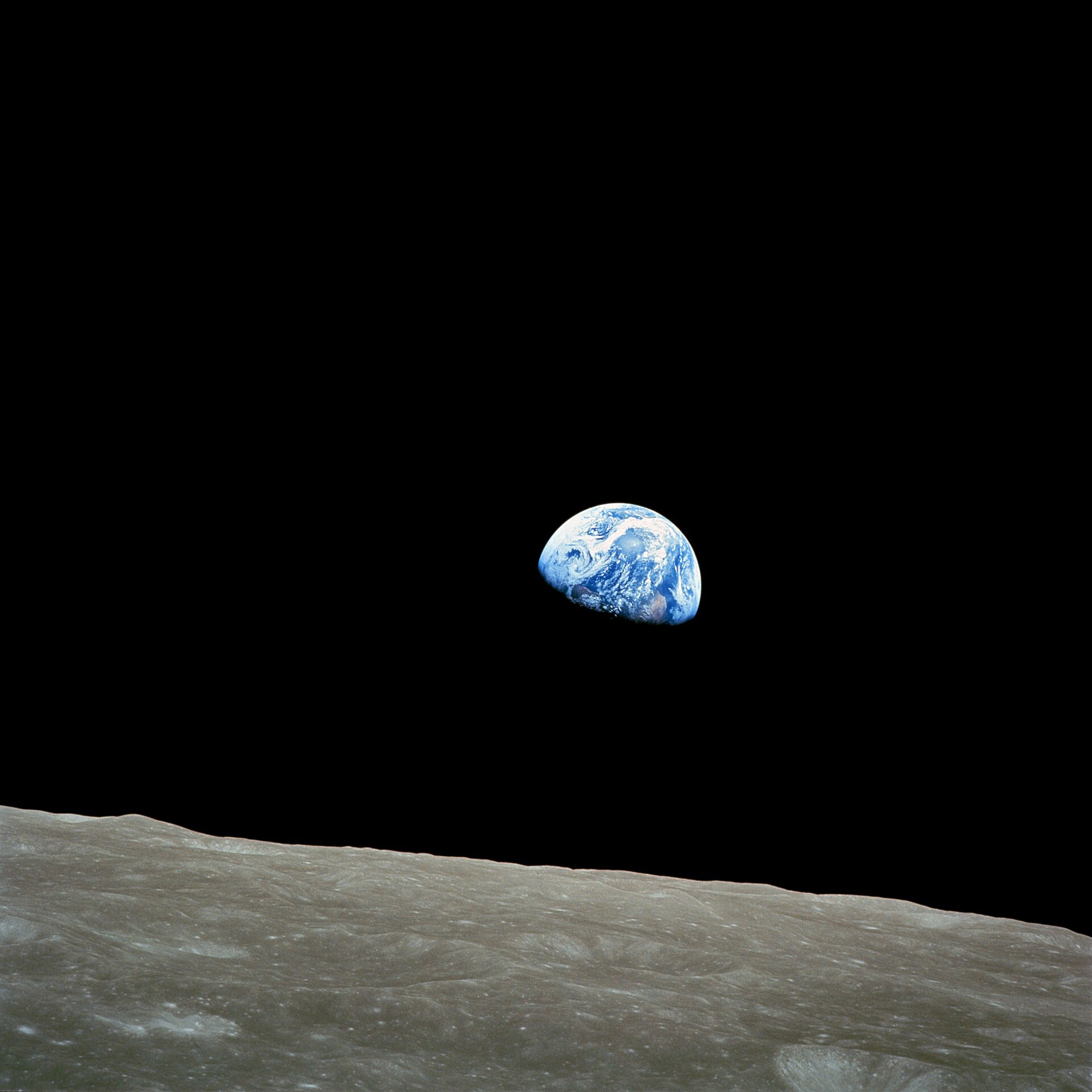 Continue reading · What happened next?Nobody Planned to Photograph the Earth From the MoonApollo 8's photographic checklist was full of lunar craters. When the Earth appeared over the horizon, the crew scrambled for colour film — and briefly joked that the shot was not scheduled.
The picture arrived into an argument that was already running. Since the mid-1960s campaigners had been demanding that NASA release a photograph of the whole Earth, on the explicit theory that seeing the planet entire would change how people thought about it. Apollo 8's Earthrise, four years earlier, had given the environmental movement its first such image.
So the Blue Marble did not create an idea; it completed one. It was the picture people had been asking for, delivered at the end of the programme, and it went straight onto book covers, posters and campaign material because a constituency for it already existed.
Free to use, and that is the point
Because it was made by NASA employees on duty, the photograph is in the public domain. It has since appeared on flags, book covers, protest banners and phone home screens. No licensing department stood between it and the world, which is a large part of why it travelled so far.
Later “blue marble” images published by NASA are usually something different: composites assembled from satellite data over hours or days, not single exposures. This one is a photograph, taken through a window, by a person.
Image record & sources
- Photographer
- Apollo 17 crew (NASA)
- Date made
- 7 December 1972
- Collection
- NASA
- Licence
- Public domain
- Attribution
- NASA / Apollo 17 crew. Public domain (work of the US government).
- File checked
- Licence page for this exact file — verified 29 August 2026
References
Continue on these topics
Tags
About the author
Forgotten Frame Editorial Desk
Editorial team
The Forgotten Frame editorial desk researches photographic archives, checks the licence of every individual file we publish, and writes the verified context around each picture.