Part ofWhere Are They Now?The Photo That Changed Everything
The Most Famous Kiss in History Was Not a Romance, and the Free Version Was Shot by the Navy
A photograph everyone thinks they know: two cameras, two owners, contested identities and a first-hand account recorded for the Library of Congress.
PUBLIC RECORDCentral claim classification. Reported and disputed material is labelled in the text.
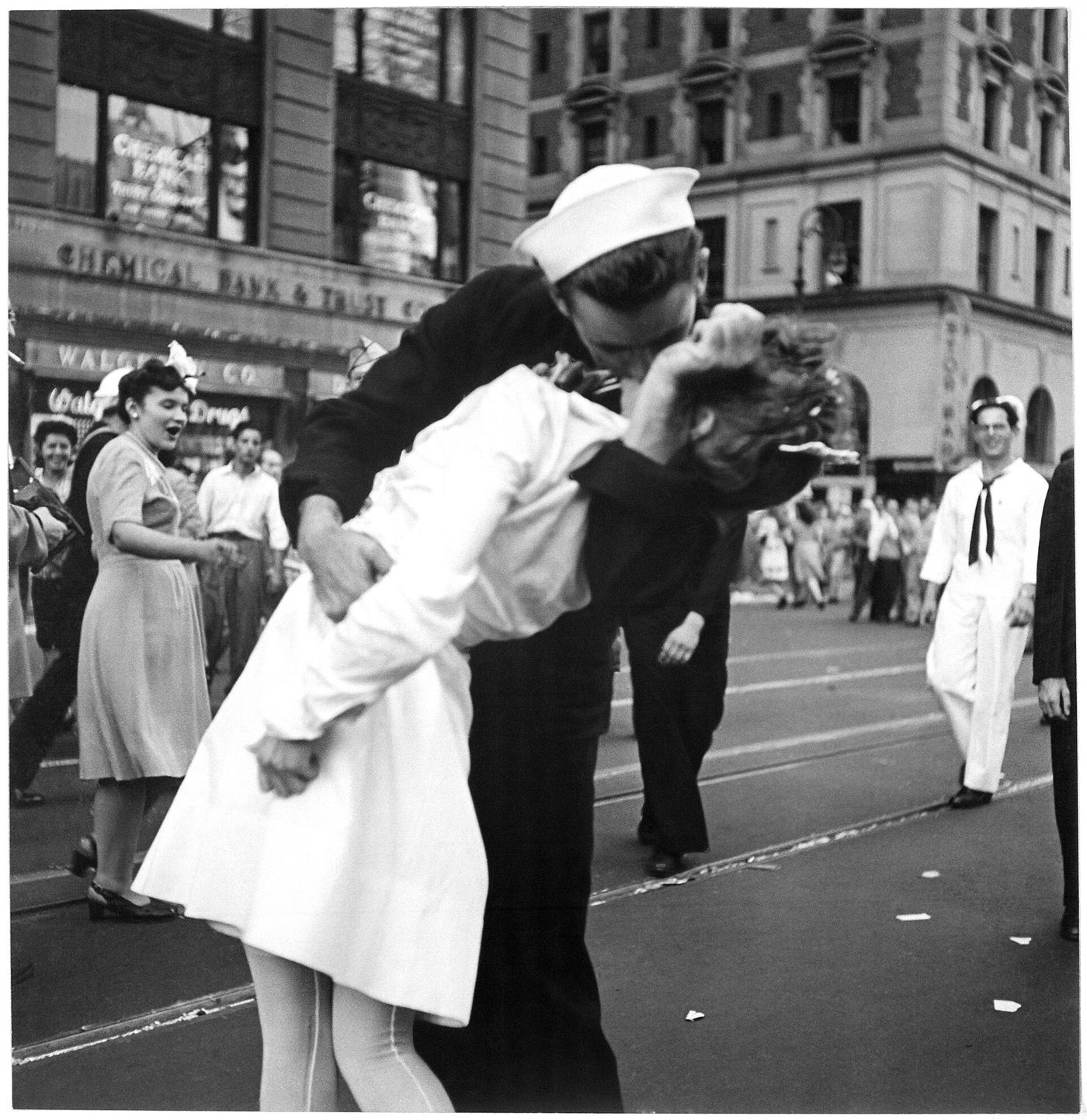 Victor Jorgensen, US Navy / Public domain
What the paperwork records
On the afternoon of 14 August 1945, news that Japan had surrendered reached New York. Times Square filled. A sailor moved through the crowd kissing women he did not know, and at some point took hold of a young woman in a white dress and bent her backwards.
Two photographers caught it. Alfred Eisenstaedt, working for LIFE, shot a sequence from one angle; his frame ran in the magazine and became one of the most reproduced photographs ever made. Victor Jorgensen, a US Navy photographer, shot the same embrace from slightly to the side. His picture, filed as a Navy photograph and titled 'Kissing the War Goodbye', is a work of the United States federal government and therefore in the public domain. Eisenstaedt's is not, and never has been. That single legal difference is why the image at the top of this page is the one you see less often.
How it unfolded
14 August 1945
President Truman announces Japan's surrender. Crowds fill Times Square; Eisenstaedt and Jorgensen both photograph the same embrace.
27 August 1945
LIFE publishes Eisenstaedt's frame. No names are recorded — he did not stop to ask who either person was.
1980
LIFE appeals for the participants to come forward. Multiple men and several women identify themselves; the magazine reaches no conclusion.
2005
Greta Zimmer Friedman records an interview for the Library of Congress Veterans History Project describing being kissed by a stranger she had never met.
2012
A book-length investigation using photographic and physical evidence argues for George Mendonsa as the sailor and Friedman as the woman. It remains an argument, not an official finding.
8 September 2016
Greta Zimmer Friedman dies, aged 92.
17 February 2019
George Mendonsa dies, aged 95.
What can be verified
- Two separate photographers, Eisenstaedt for LIFE and Jorgensen for the US Navy, photographed the same embrace from different positions.
- Jorgensen's frame is a US federal government work in the public domain; Eisenstaedt's remains under copyright.
- Neither photographer recorded the names of the people in the picture.
- Greta Zimmer Friedman, a dental assistant — not a nurse, despite the caption that follows the image everywhere — described the moment in a recorded 2005 interview for the Library of Congress.
- No official body has ever certified the identity of either person.
The part the caption leaves out
The photograph is filed under celebration, and the celebration was real: the war had ended that afternoon and the city had emptied into the street. But the woman's own account, recorded for a federal oral-history programme and archived at the Library of Congress, describes something more one-sided than the caption suggests.
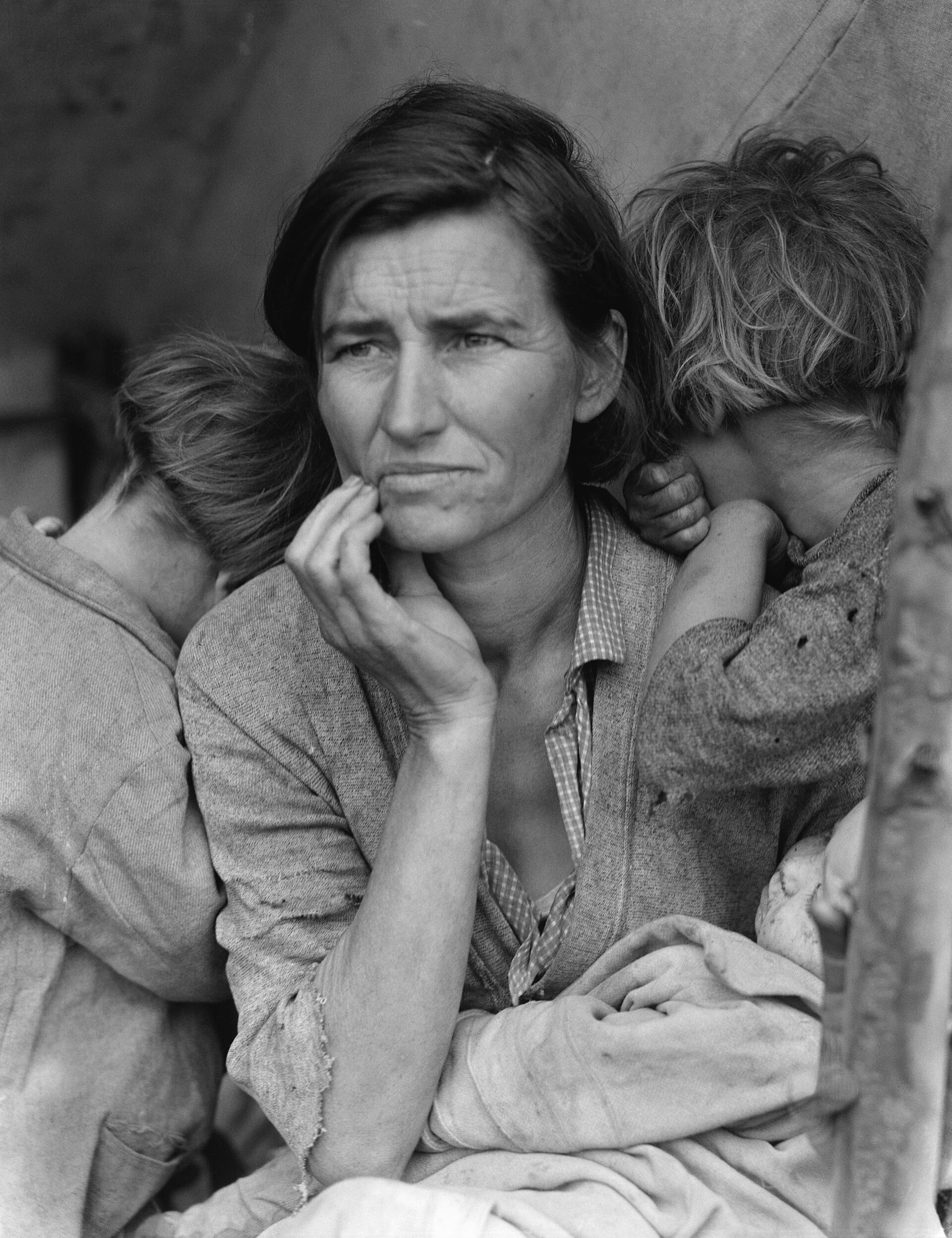 Continue reading · What happened next?The Most Famous Photograph of the Depression Took Ten Minutes to MakeDorothea Lange stopped at a pea-pickers' camp, shot five frames and drove on. The woman in the picture spent the rest of her life objecting to how it was used.
“It wasn't my choice to be kissed. The guy just came over and grabbed. That man was very strong. I wasn't kissing him. He was kissing me.”
Friedman also said, in the same interview and in others, that she did not regard it as an assault and understood it in the context of the day. Both halves of that are hers, and we print both. What is not defensible is the version that survives on posters and mugs, in which two strangers who never spoke are presented as a romance.
Why nobody can prove who they were
By the time LIFE asked, in 1980, the crowd had had thirty-five years to remember being in it. Eleven men and three women eventually put themselves forward. The most-supported case, argued in a 2012 book using shadow angles, tattoos, scars and the position of a woman visible behind the sailor, points to George Mendonsa, a Navy quartermaster on shore leave, and to Friedman. Mendonsa's own case is strengthened by the fact that the woman he was actually on a date with that afternoon — Rita Petry, whom he later married — appears in the background of Eisenstaedt's frame.
It is persuasive. It is not a finding. LIFE never certified anyone, and the archives that hold both negatives record no names.
Afterwards
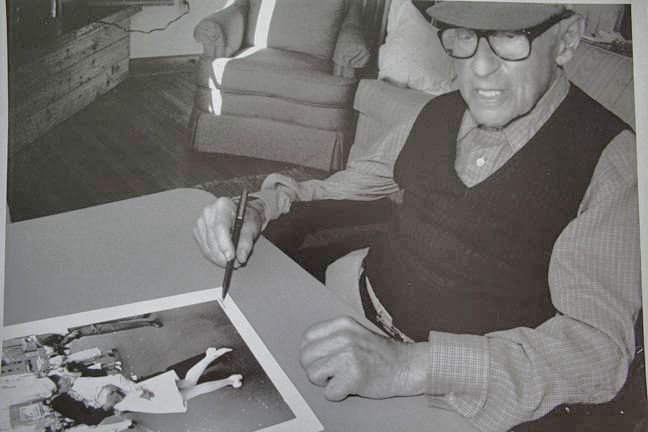
Eisenstaedt worked for LIFE until the magazine's weekly run ended and died in 1995 on Martha's Vineyard, days after signing prints of the picture at his cabin there. Jorgensen's Navy career left his frame in the National Archives, free for anyone to publish — which is why it appears in textbooks, on this page, and in a thousand places where the LIFE image would have required a licence.
Friedman gave her interview to the Library of Congress in 2005 and died in 2016. Mendonsa died in 2019. Neither was ever paid for the most reproduced kiss of the twentieth century, and neither claimed they should have been. The picture belongs to a moment; two-thirds of it, legally, belongs to the public.
Image record & sources
- Photographer
- Victor Jorgensen, US Navy
- Date made
- 14 August 1945
- Collection
- US National Archives via Wikimedia Commons
- Licence
- Public domain
- Attribution
- Victor Jorgensen, US Navy. Public domain (work of the US federal government), via Wikimedia Commons.
- File checked
- Licence page for this exact file — verified 30 August 2026
References
- US National Archives — Victor Jorgensen, 'Kissing the War Goodbye' (Navy photograph 80-G-377094)
- Library of Congress — Veterans History Project, Greta Zimmer Friedman interview
- Naval History and Heritage Command — photographic collections
- Encyclopædia Britannica — V-J Day
- Wikimedia Commons — file and licence page for the Jorgensen frame
- Encyclopædia Britannica — Alfred Eisenstaedt
Continue on these topics
Tags
About the author
Forgotten Frame Editorial Desk
Editorial team
The Forgotten Frame editorial desk researches photographic archives, checks the licence of every individual file we publish, and writes the verified context around each picture.